
That has to be the hollowest of holiday greetings. In a best case, you’ve submitted your income tax returns and are now patiently awaiting a refund on overpaying last year. Nobody enjoys paying taxes. However, most of us understand we all ‘chip in’ to cover the costs of running a successful and healthy society. We might grumble, but stuff like bridges and highways are important to all of us.
We pay a lot of different taxes: federal and state income taxes; property taxes; state and local sales taxes; and all sorts of assessments on everything from buying a hunting license to registering a kayak. Fuel taxes‒federal and state fees we pay on every gallon we pump‒are understood by few drivers. And as you might guess, fuel taxes are even collected on the cleaner-burning fuel alternatives to gasoline and diesel fuel.
 Years ago, Minnesota policymakers wisely based state motor fuel taxes on the energy content of each fuel relative to the energy found in gasoline. It might have been because Minnesota has no oil resources of its own and fuel diversity has long been encouraged…or it might be that the North Star State has an environment-focus and burning less gasoline and diesel helps lower risks to air and water. Whatever their reasoning back in the 1990s, it was forward-thinking and helped build Minnesota’s use of alternative fuels.
You see, every fuel type contains a unique amount of energy or ‘energy units per gallon.’ If you are paying the same tax on a metered gallon of propane, natural gas or E85, you are being ‘over-taxed’ compared to a driver buying gasoline. And, of course, that is a dis-incentive to use those alternative fuels.
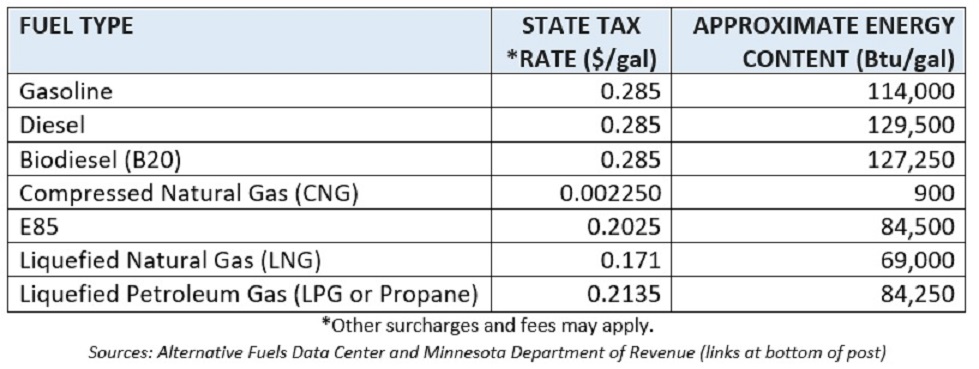
In the United States, fuel energy content is commonly measured in British thermal units per gallon (BTUs/gal). A gallon of liquid diesel contains the most energy at about 129,500 BTUs/gal, while gaseous CNG contains the least at 900 BTUs/gal. To treat the motor fuels fairly, Minnesota tax collectors did a little math to convert them all to a common starting point based on the energy content of gasoline. It is referred to as ‘gallon of gasoline equivalent’ or GGE. The chart below compares various motor fuels and tax rates presently in Minnesota law (click on the chart to enlarge it).
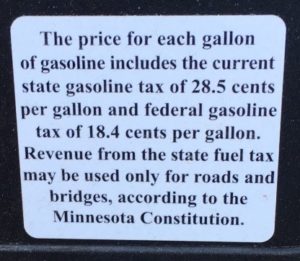
American drivers also pay federal excise taxes of $0.184 per gallon on gasoline and $0.244 per gallon on diesel fuel. According to the U.S. Energy Information Administration, an average American burned about 656 gallons of gasoline in 2016. If a Minnesotan fits that average, they paid roughly $121 and $187 in federal and state taxes, respectively.
Many people mistakenly think those “road taxes” cover the cost of building and maintaining our roads and bridges. Unfortunately, it’s been a long time since those were enough to pay for all of that work. Going forward, if we anticipate higher fuel economy vehicles and electric models are to become the norm, we will need to find creative ways to afford the infrastructure on which we all depend.