


Ceramic whistle in the form of the maize god, Chama, Guatemala (c.600-900 A.D.) Tulane University.
Corn is the largest crop in the United States — suppling feed, food, fiber, and fuel in thousands of products important to our daily lives. This Oct. 10 marks Indigenous Peoples’ Day, a time for remembering the people who brought corn to the world and a good reminder that corn has been a staple in American life for a very long time.
By now, everyone knows Tariq loves sweet corn and “It has the juice!” And faithful fans of the Better Fuel Initiative understand field corn is the kind used in feeding livestock and production of the ethanol in Unleaded 88 E15 and other biofuel blends.
In 2021, our Minnesota farmers harvested 7.84 million acres of field corn, the most common variety. They also supplied 25% of all U.S. sweet corn from an additional 93,000 acres.
But did you know Americans have been depending on corn (Zea mays) for 10,000 years?
First domesticated from Teosinte, a grass still found in central Mexico, early versions of corn spread with migrating native peoples and along their continent-wide trade routes. Corn was grown in what is now the southwestern United States by 4,000 years ago, and it had already become a staple of daily life to Atlantic coast tribes 2,000 years before Columbus set sail on his voyage.
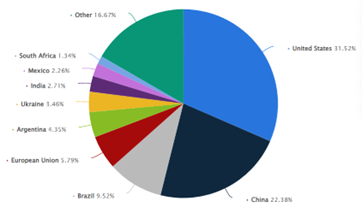
2021-2022 Distribution of Global Corn Production by Country (Statista)
By 2,500 years ago, corn cultivation reached present day Minnesota, spreading northward along the Mississippi River. When Europeans arrived in the northern regions, they encountered natives growing squash, beans, and corn at Red Lake and Lake of the Woods.
Modern corn varieties with their large cobs of plump kernels are very different from their grass-like ancestors. Breeding and genetic technologies allow today’s farmers to plant seeds that combat the disease, drought and pests that would’ve decimated ancient crops. However, many beautiful heirloom breeds have been preserved and are enjoyed today. Red Lake Corn with its blue and white kernels is an example still grown by Ojibwe of northern Minnesota.
Today, corn is grown on every continent except Antarctica. In 2021-2022, its global production of 1.2 billion metric tons tops that of other grains such as wheat, milled rice, and barley. From humble beginnings millennia ago to the staple of modern life it has become, corn is a gift to the world from those first Mesoamerican farmers.