
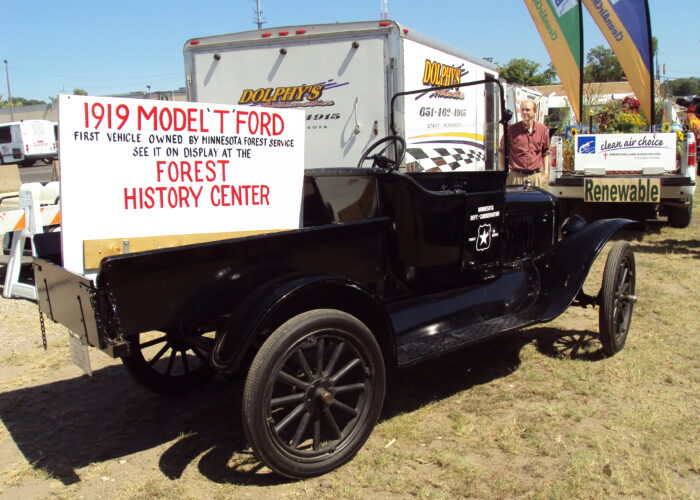
No, Henry Ford did not invent the automobile. He wasn’t even first to build a horseless carriage in the United States. However, Ford is credited as the first to mass produce a car and his assembly line methods lowered costs, making the Model T affordable to millions. The “Tin Lizzy” (or “Leaping Lena”) is considered the most successful automobile of the 20th Century. Ninety-five years after the last one rolled off an assembly line, the Model T still ranks eighth on the list of all-time best-selling automobiles.
What was the first car? That’s more difficult to answer.
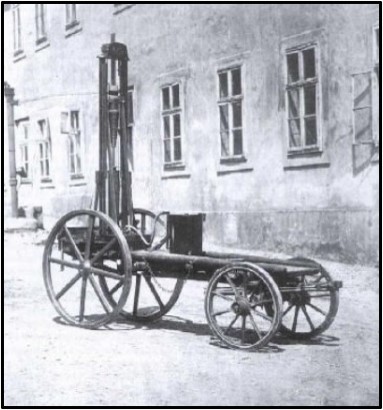
“Car” built by, but not patented by Siegfried Marcus. c. 1870.
Who?
Carl Benz is credited with patenting the first car, the Benz Patent-Motorwagen, of which he built several in the 1880s. This January marked the 136th Anniversary of that patent. Today, the Benz name lives on in Mercedes-Benz.
However, Austrian Jewish inventor Siegfried Marcus ought to be recognized as the inventor of the first gas-powered car. Marcus patented 131 inventions, but in the 1860s he failed to file for the petroleum-fueled engine-powered cart he puttered around the streets of Vienna. Tragically, all recognition of Marcus was expunged by the Nazis when Germany annexed Austria in 1940.
What?
What constitutes the first “car” is a matter of opinion. An argument can be made for Nicholas-Joseph Cugnot’s steam-powered road tractor. Designed for the French army in 1769, his unwieldy beast was capable of pulling five tons at speeds up to 2.5 miles per hour. A prototype survived the French Revolution and is preserved at the Musee des Arts et Metiers in Paris.
In the early 19th Century, lumbering coal-fired steam-powered goliaths popped up in Great Britain and elsewhere. They must’ve
been loud, dirty and slow; impractical compared to the horse-powered wagons and carriages of the day. Modern reconstructions resemble locomotives or steam threshers rather than what we keep in our garages.
ICE-Power
Other car-like machines are reported from Asia and Europe as early as the 1600s. The car’s evolution closely followed that of small power sources—first steam; then electric motors; and finally liquid-fired models. Nicolaus Otto (yes, like “auto”) was producing reliable internal combustion engines (ICEs) by the 1870s.
Availability of small, dependable liquid-fueled ICEs led directly to ascent of the modern automobile. With that many carmakers followed Marcus and Benz. Starting in the 1890s, possibly as many as 2,000 American companies eventually formed to produce 3,000 different models. The rest, as they say, is history.
Future?
Love ‘em? Hate ‘em? Automobiles have arguably done more to transform society and, unfortunately, our environment than any other technology. What’s their future? Will we all ride in self-driving EVs? Will we have greater access to renewable low-carbon biofuel and flex-fuel models? Time will tell.
Did You Know?
Minnesota is home to the world’s oldest Ford dealership, Tenvoorde Ford of Saint Cloud. They signed with Henry Ford back in 1903 prior to Model T production. Today, Tenvoorde still sells descendants of the Tin Lizzy.