
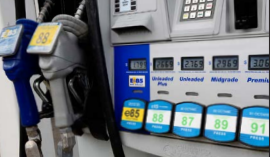
How much attention do you pay to the dispenser when you fuel up your car? Fuel dispensers come in different shapes, sizes and colors. Some have lots of stickers and buttons. Still others have screens running video ads and local weather forecasts. They stand out on fuel islands day and night in all sorts of weather, winter and summer.
If you’re a biofuel fan like me, you may think too much about these sentinels of the fuel island. Fuel dispensing “blender pumps” are one of the technologies that have allowed retailers to grow availability of 88 octane E15 and E85 flex fuels.Have you ever considered the dispenser hoses, nozzles and buttons? Most have one or a couple. But some have a ridiculously confusing tangle of too many.
Maybe you’ve seen blender pumps at your local stations. For years, they’ve been used to blend gasolines from multiple, separate tanks. For example, if regular 87 octane is in one tank and high-octane premium in another, the dispenser allows the mixing of those into a third “blended” midgrade gasoline. In the simplest design, two tanks provide three gasoline grades via a dispenser with a single hose and nozzle.
In the last decade, the same concept has been used in marketing renewable-based, ethanol fuels beyond familiar E10, the preeminent U.S. gasoline. For example, retailers have used tanks of regular gasoline, premium gasoline and E85 combined with blender-type dispensers to offer motorists a spectrum of fuels including E10, 88 octane E15 and E85 flex fuels.
All equipment used to handle fuel, both above and below ground, is regulated by strict rules to protect public safety and to prevent fuel spills. Components are certified by Underwriters Laboratories and similar organizations, while state and local authorities oversee compliance prior to station owners beginning operation.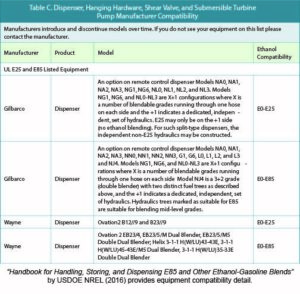
Currently, the two primary manufacturers of retail fuel dispensers are Wayne and Gilbarco. Both companies offer dispensers approved for use of fuels up to E25 (containing 25% ethanol) as well as options for up to a maximum of E85. This 2016 handling guide by the U.S. Department of Energy National Renewable Energy Laboratory provides an overview.
Perhaps not surprisingly, motorists may get confused while standing at a fuel island. When E15 is sold through hoses and selection buttons separated from the other gasolines, it looks “different” and not like a “normal” fuel. If any fuel is singled out, sales tend to suffer, and in that moment their hand hovers above the selection buttons, looking different is a negative. It can cause some customers to hesitate.
When a station’s dispenser presents all the fuels more uniformly, customers view E15 as another gasoline blend (which it is). It also helps that E15 is typically priced the same or lower than regular 87 octane gasoline, and provides a midgrade octane rating.
Fuel sales are influenced by many site-specific details including pricing, signage and in-store sales. The savviest retailers know how to market all their fuels – and E15 is no different.